The AI content workflow for early-stage startups
How early-stage startups and small agency teams turn one idea into a full publication package: blog, social, email, without a marketing team or AI slop.

Most early-stage startups and small agency teams are already using AI for content. The CMI's 2026 B2B report puts it bluntly: 94% of B2B marketers plan to use AI for content creation this year, and non-AI blog creation dropped from 65% to just 5% in two years. So the interesting question is no longer whether to use AI. It's what your AI content workflow for early-stage startups actually looks like once the novelty wears off.
Because there's a gap nobody is talking about loudly enough. 81% of B2B marketers report using generative AI tools, only 19% have integrated it into a daily workflow. Most teams own the stack. Few own the sequence. And a stack is not a workflow.
This piece walks through what an end-to-end AI content workflow looks like for the two audiences it has to serve in the wild: a founder running marketing solo at a pre-seed or seed startup, and a small comms agency team running content for multiple clients. Different constraints, the same question underneath: how do you go from one captured idea to a full publication package (article, social, email, images) without hiring a content department or shipping AI slop?
AI adoption is solved. Workflow isn't.
The dominant pattern in the "AI for content" advice space right now is the tool listicle. 9 best AI content tools for startups. 12 AI workflows for marketing teams. Best AI content platform for agencies. They list 7 to 12 tools and stop short of the workflow itself.
That gap is the problem. If 94% of marketers have AI tools and only 19% have a working daily workflow, the bottleneck isn't tool access. It's sequence design. The teams quietly winning aren't running more tools, they're running one workflow, end to end, the same way every week.
Tool sprawl actively works against small teams. Three disconnected AI tools with three different prompt patterns produce three different brand voices in the same week. Consolidate where you can. Standardize on a small set of tools and document how the team uses them. One workflow per brand, not one prompt per post.
What an end-to-end AI content workflow looks like
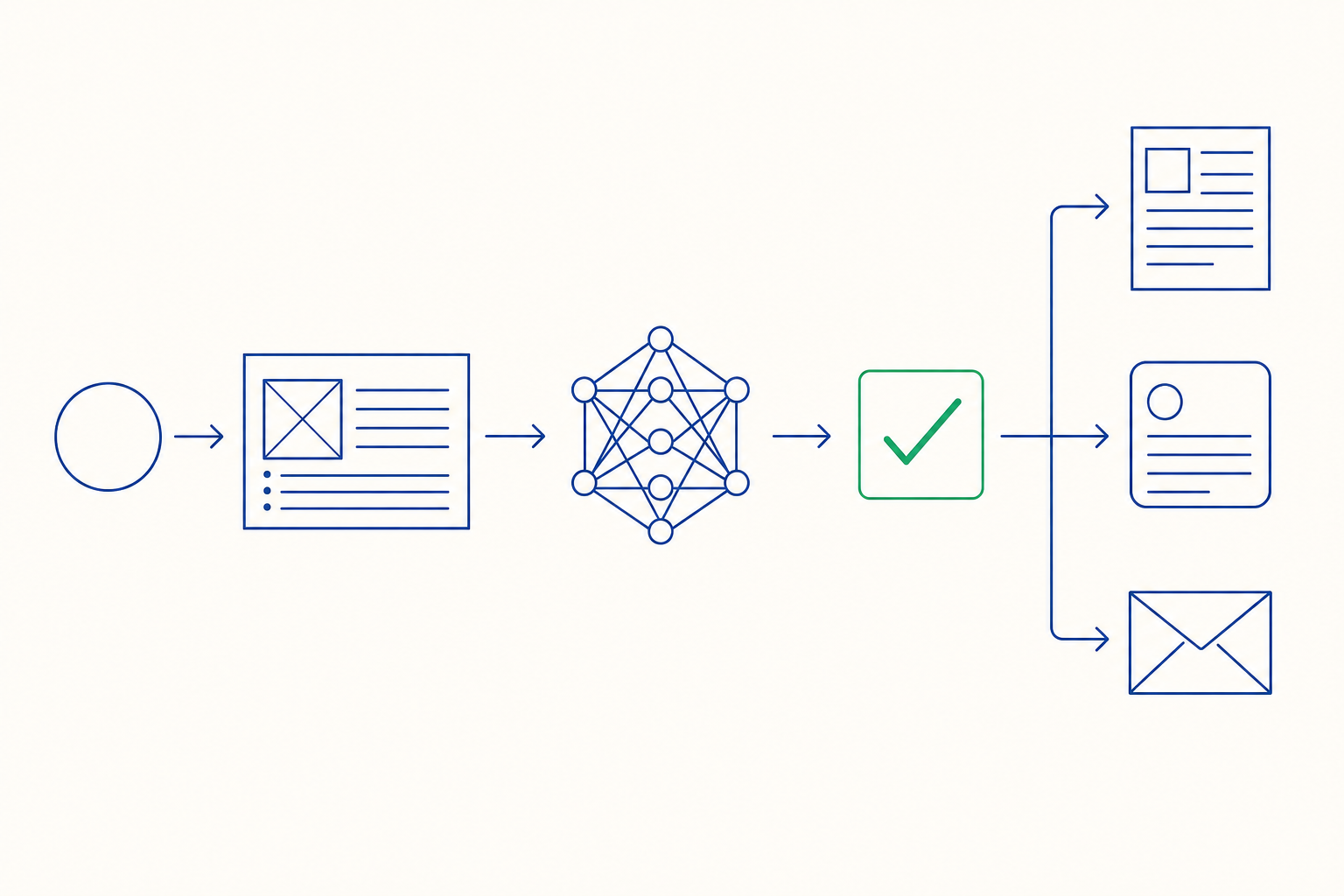
Underneath every workflow that actually ships, the shape is the same: trigger → input source → AI model → destination output. The interesting design choice is what sits between the model and the destination. If your "workflow" lets a model draft go straight to publication, you don't have a workflow, you have an output pipe.
The non-negotiable step is the editorial pass between draft and publish. That's what separates the teams seeing real time savings from the ones producing the "AI slop" we'll get to in a minute.
Two practical numbers anchor what's possible:
- A structured workflow cuts per-piece production from around 3.8 hours of manual work to roughly 9.5 minutes. That's the best case the industry cites, not the average, and it only holds when the workflow includes a structured brief, a brand voice profile, and a real editorial pass.
- The unlock is front-loaded. A one-time brand voice setup of around four hours produces a profile that then drives roughly 70-minute-per-piece production, three polished posts a week within the time budget that used to produce one.
That second number is the one most teams miss. Voice setup is the one investment that pays back across every piece downstream. Skip it and you reproduce the failure mode this whole article is about.
Running content without a marketing team (founder lens)
For a pre-seed or seed founder running marketing solo, the workflow has to survive the founder's actual time budget, not an imaginary one. Realistic seed-stage cadence is 3 to 6 hours per week of total content time, with two blog posts per month as the baseline.
Most "publish five times a week" advice is written for people with content teams. Outside that context, it fails predictably: the founder runs the workflow once, can't sustain it, and either drops the cadence or ships unreviewed batch output that trips the failure modes we'll cover below.
The other thing founders consistently get wrong is treating AI as a replacement for their voice instead of an amplifier of it. In the early days, the founder is the best content creator the company has. You hold market knowledge and an authentic voice that hired writers can't replicate. The workflow's job is to amplify and distribute that voice, capture an idea, structure the brief, draft from your patterns, review against your voice profile, and ship across channels.
One more honest number: distribution effort should match production effort. Around 30% of total content time should go to distribution, not just creation. The "publish and pray" content fails for the same reason the "AI slop" content fails, nobody actually sees it.
Scaling client work without voice collapse (agency lens)
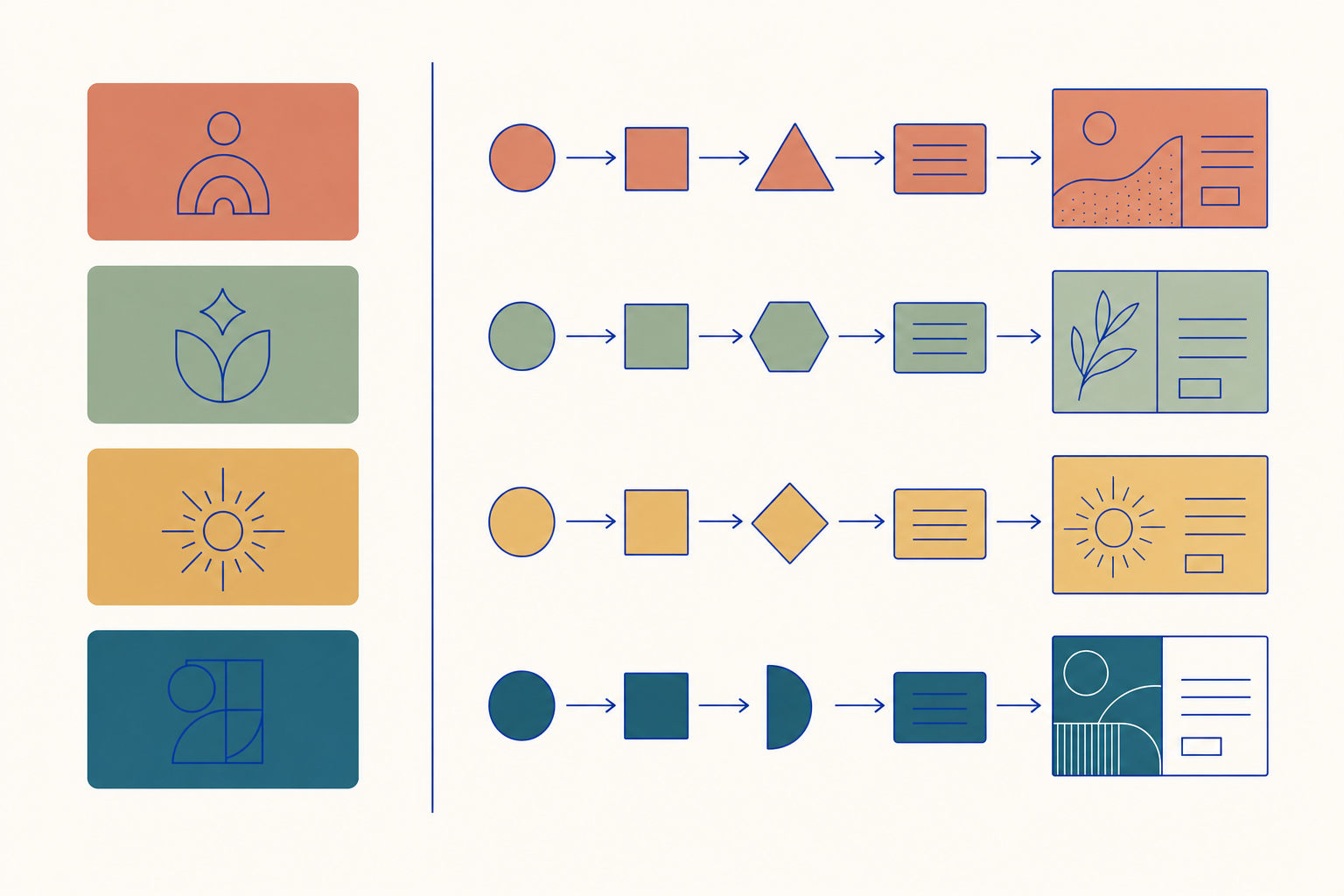
If you're a small comms agency running content for clients, the workflow ROI looks completely different. It isn't measured in founder hours saved. It's billable capacity you couldn't sell before. Small agencies adopting structured AI workflows manage 50 to 100% more clients without proportional headcount, while cutting per-piece production time 40 to 80%.
That capacity math only works if you avoid the agency-specific failure mode: cross-client voice collapse. Without a per-brand voice layer in the workflow, every client's content slowly converges on the same generic, model-default voice. You don't notice it on any single piece. You notice it three months in, when two clients sound the same in their newsletters and one of them mentions it on a call.
The fix is structural, not stylistic. Build one voice profile per client, kept in version control alongside that client's positioning and brand docs. Every workflow run loads that client's profile as the first step. The same workflow shape, multiplied by N clients, each with their own voice layer. That's how the agency math holds.
Where AI content fails: how the workflow protects you
There are real failure modes worth taking seriously. None of them are arguments against AI in content, they're arguments for the workflow.
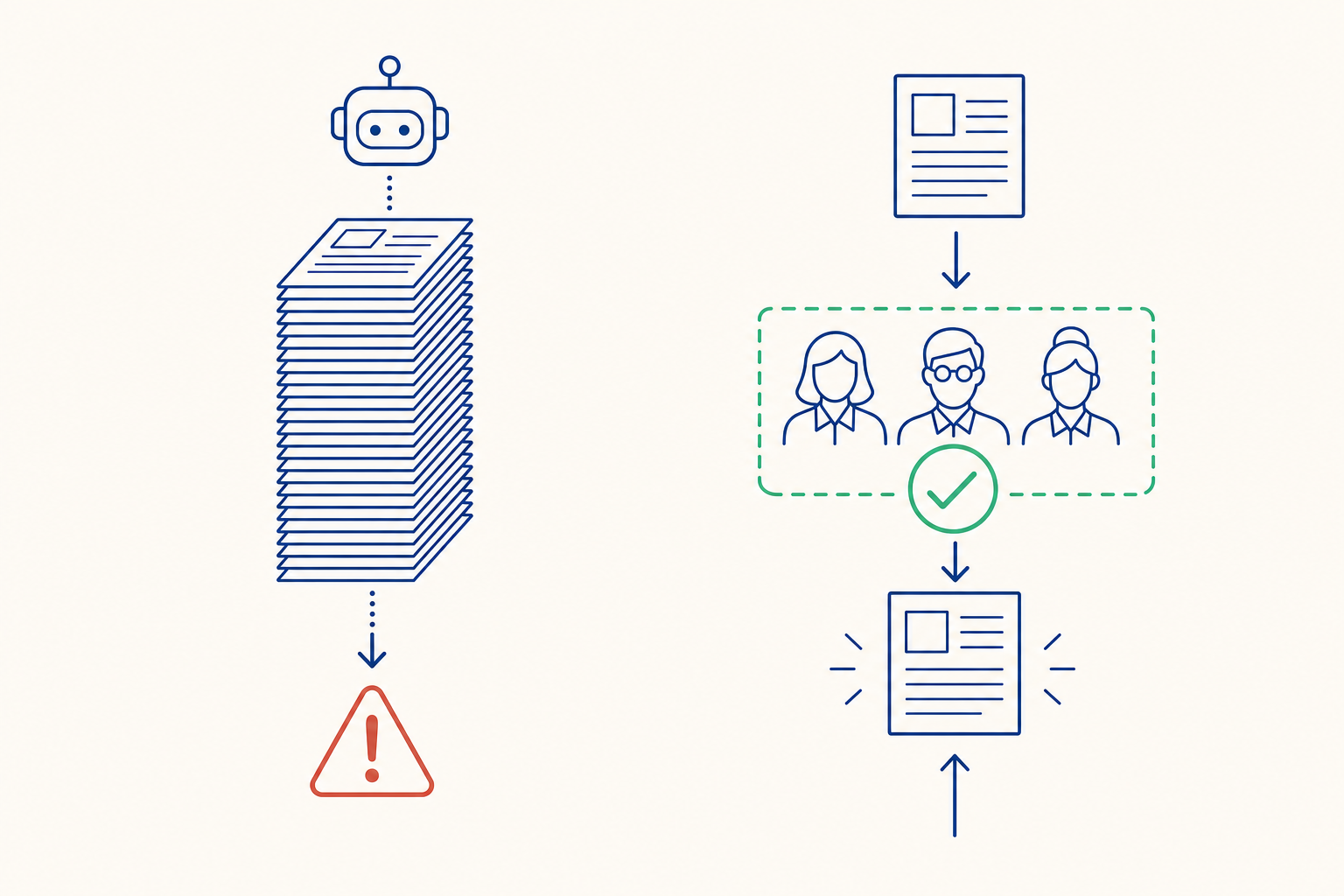
Unreviewed output measurably degrades engagement. When AI-only drafts ship without an editorial pass, bounce rate goes up and time-on-page goes down. Underlying signals aren't helping: a 2025 study found 59% of people trust online content less than they used to, and 78% say it's getting harder to tell AI from human writing. The fix isn't "use less AI." It's "make the review step non-negotiable". The 10-minute-per-piece time benchmark assumes a workflow with a review pass; reading it as "10 minutes of pure model output" reproduces the exact problem this objection is naming.
Visible AI authorship is a brand-trust liability. "AI slop" was Merriam-Webster's 2025 word of the year. Coca-Cola, Svedka, and H&M took sustained criticism for openly AI-branded campaigns; Gen Z is turning away from content that reads as AI-authored. The pushback is against visible AI output, not AI assistance. The workflow's job is to produce output that doesn't look or feel AI-authored, even when it's AI-assisted. That's what the voice profile and editorial pass are for.
The "soulless AI content" objection is partly right. Generic AI output exists, it does damage real engagement, and the workflow has to prevent it. But what's failing there is the missing review step. AI isn't the variable. Teams that ship from model straight to publication get the generic output; teams that ship from model through a structured voice and editorial pass get content that performs.
SEO in 2026: what Google actually penalizes
Worth clearing one objection that comes up in every agency Slack at least once a month: won't Google penalize AI content?
The short answer is no, not because Google likes AI content, but because the policy doesn't target authorship. Google's "scaled content abuse" policy went into effect in June 2025 and was named explicitly in the March 2026 core update. What it targets is mass-produced AI pages without editorial oversight or unique value. Sites publishing hundreds or thousands of unreviewed AI pages saw 50 to 80% traffic drops in the March 2026 update.
That's a behavior penalty, not an authorship penalty. And the data backs it up. An Ahrefs study of 600,000 pages found that 86.5% of top-ranking pages already use some AI assistance, with near-zero correlation between AI use and ranking penalties; roughly 17% of top-20 search results were AI-generated as of 2025.
So the rule is simple, and it has nothing to do with authorship. Google penalizes scale-without-review. A workflow that includes a real editorial pass produces content that ranks. A workflow that doesn't, produces content that gets caught. The question your team has to answer isn't "AI or not." It's "what's the editorial step that sits between the model and the publish button?"
What this looks like in practice
A workflow we run ourselves at VibeMyWay (this article was produced through it):
- Capture the idea. One sentence, somewhere durable.
- Research the keyword cluster and pull the substantive backbone (sources, claims, stats, counterarguments) into a concepts brief.
- Draft the article from that brief, with the brand voice profile loaded as context. Every numeric claim cites a source from the brief.
- Review for voice, accuracy, and the AI-tell patterns that signal "generic." This is the non-negotiable step.
- Atomize into the channel-specific package, social posts, newsletter, email sequence, supporting images. Same workflow, different output shapes.
- Publish across channels, with distribution time built into the budget.
The point isn't this exact sequence. It's that there is a sequence, owned in one place, with the editorial pass treated as part of the workflow, not as a "best practice" tacked on at the end. That's the difference between a stack and a workflow, and it's what makes 70-minute-per-piece production realistic instead of theoretical.
Sources
- [S1] B2B Content Marketing Report 2026, Content Marketing Institute, fielded Jun–Aug 2025, N>1,000 B2B marketers
- [S2] Does Google Ignore AI Content? What the Data Says, Snezzi (citing Ahrefs N=600,000 study), 2026
- [S4] Best Content Marketing Workflow for Seed-Stage SaaS Startups, Averi, 2026
- [S5] The AI-Assisted Content Workflow for Founders, 2026 Hybrid Model) (Foundera, 2026
- [S6] How to Create AI-Assisted Content Workflows for Agencies, Averi, 2026
- [S7] Content Marketing for Startups: A Practical Strategy, Funded.club, 2026
- [S8] Why AI-Driven Creative Is Failing and How to Fix It, MarTech, 2025
- [S9] Why AI-Generated Holiday Ads Fail, Nielsen Norman Group, 2025
- [S10] FAQ on Content Marketing: AI Saturation, Zero-Click Search, What's Still Working in 2026, eMarketer, 2026
- [S11] Scaled Content Abuse: Google's AI Page Crackdown Guide, Digital Applied, 2026
- [S12] AI Content Creation Workflows: Scale Quality Content, NAV43, 2026
- [S13] Agentic AI for Content Marketing: How SMBs Are Automating 80% of Their Workflow, qd-up, 2026
FAQ
What is an AI content workflow?
An AI content workflow is a documented sequence (trigger, input source, AI model, editorial review, destination output) that one team runs the same way every week to produce content. It's the structural opposite of a "stack" of disconnected AI tools used ad hoc. The differentiator is the editorial pass between model output and publication, which is what separates real workflows from output pipes.
How should an early-stage startup set up its content workflow?
Realistic seed-stage cadence is 3–6 hours per week of content time, with two blog posts per month as a defensible baseline. Front-load a one-time brand voice profile (around four hours), then run the workflow weekly: capture an idea, brief, draft from the voice profile, review, atomize into social and email, publish. Treat the editorial review step as non-negotiable.
How do small agencies use AI for content without losing per-client voice?
Build one voice profile per client, version-controlled alongside that client's positioning and brand docs. Every workflow run loads the relevant client's profile as the first step before drafting. The workflow shape stays constant; the voice layer multiplies. Without this, brands quietly converge on a generic model-default voice, the agency-specific failure mode called cross-client voice collapse.
Will Google penalize my AI-generated content?
Google does not penalize AI authorship. Its scaled content abuse policy (active June 2025, enforced visibly in the March 2026 core update) targets mass-produced unreviewed AI pages, behavior, not authorship. 86.5% of top-ranking pages use some AI assistance with near-zero correlation to ranking penalties. The protective step is a real editorial pass, not avoiding AI.
How long does an AI content workflow take per piece?
After a one-time brand voice setup of around four hours, structured workflows hit roughly 70 minutes per piece for polished output. The widely-cited best case is 3.8 hours of manual work compressed to around 9.5 minutes, but only when the workflow includes a structured brief, voice profile, and editorial review. Without those, the 10-minute benchmark is just the AI slop benchmark.
Ready to run this workflow?
If you want the workflow described here packaged and ready to run (voice profile setup, brief structure, draft + atomization, editorial step, distribution) that's what we built. See vibemyway.com/launch for ContentMind (for writers and creators) and MarketingKit (for founders and small agency teams running the whole content function).