Marketing Automation for Small Business: Fix the Sequence
Marketing automation for small business fails on complexity, not capability. Skip the bloated tools: define the sequence, start with two workflows, ship.

You opened three tabs to set up marketing automation, watched a 40-minute onboarding video, mapped out a workflow with five branches, and then closed everything to go answer a customer email. The automation never got built. A week later the situation repeats.
This is the real failure mode for marketing automation for small business, not the cost, not the capability, but the setup. The tools that show up first in every roundup were built for agencies and enterprise teams, and small operators keep choosing software that's far more powerful than they need. The result is a stalled project and a founder who concludes automation "isn't for us." It usually is. The approach was just backwards.
This article covers what marketing automation actually is, why it feels so overwhelming, the reframe that fixes it, the two or three workflows worth starting with, the honest case for when to skip it, and the cost math against hiring an agency. By the end you'll know exactly where to start.
What marketing automation actually is
Marketing automation is software that runs repetitive promotional steps for you based on triggers, someone takes an action, and a sequence of responses fires without you clicking send. A new subscriber joins your list and gets a welcome email. A lead downloads a guide and gets a follow-up two days later. You build the workflow once; it runs while you do other things.
That's the whole mechanism. Trigger, then sequence. Everything else (segmentation, scoring, multi-channel campaigns) is a variation on that one idea.
Here's the part the tool roundups skip: none of this requires a developer or a big budget anymore. Packaged, predictable-price automation is widely available. What it still requires is judgment about which sequences to run, and that judgment is exactly where most small businesses get stuck.
Why marketing automation feels so overwhelming
Three causes, each one fixable once you can name it.
First, the tools are too big. The platforms that dominate every roundup were built for marketing departments with full-time operators. A solo founder loads one up and drowns in configuration before sending a single email.
Second, setup is a hidden tax nobody prices in. There's nothing automated about building automation. Wiring tools together, mapping fields, troubleshooting broken workflows, that's real, ongoing, unrecoverable time. For a lean team it's often the scarcest thing going.
Third, the tools don't talk to each other. The common reflex is to grab a CRM, an email tool, a form builder, and a scheduler and hope they integrate. They don't, not cleanly. You end up maintaining a fragile stack instead of running a workflow.
None of these is "the software can't do it." The capability exists. The barrier is everything you have to assemble before it does anything useful.
The reframe: you need a sequence, not more software
The bottleneck isn't a missing tool, it's a missing sequence. Adding software to an undefined process just gives you more surface to manage.
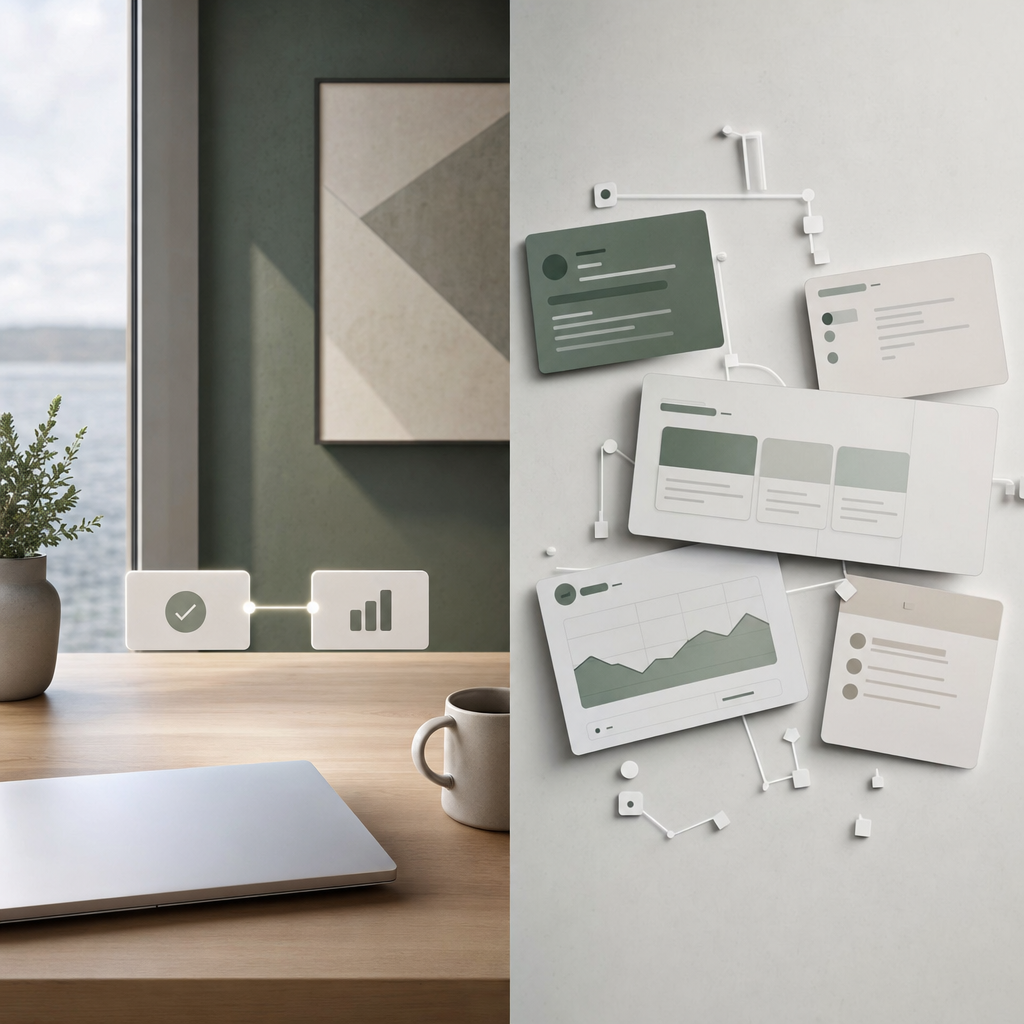
Start from the process instead. What are the two or three moments in your customer journey where a timely, automatic message would actually help, a welcome, a follow-up, a re-engagement? Define those first. The tool is downstream of that answer, not upstream.
This also explains why automation sometimes produces nothing. Automation is a force multiplier, not a substitute for substance. If you automate weak or absent content, you scale zero, you just get worthless output faster. The sequence has to carry something worth sending before the automation is worth building.
Where to start: the two or three workflows that pay back first
Resist the urge to build a stack on day one. Implement the highest-impact automations first, prove them out, then add more. Complexity compounds, every extra branch and condition multiplies the points where things break.
For almost everyone, the first workflow is a welcome-and-nurture email sequence. It's a one-time setup, it runs continuously, and it delivers value to every new subscriber. Automated emails consistently punch well above their share of volume, by one widely cited benchmark they drive 320% more revenue than non-automated sends.
A reasonable starting order:
- Welcome / nurture sequence, fires when someone joins your list.
- Lead follow-up, fires when someone downloads, books, or shows buying intent.
- Re-engagement, fires when a contact goes quiet for a set period.
Three workflows, one integrated pipeline, run end to end. That's a complete starting system, and it's worlds away from the ten-tool tangle that stalls everyone else. This is also the content half of the engine: if the messages themselves are the bottleneck, our AI content workflow for early-stage teams covers how to produce them without a team.
The honest case against it
Automation isn't always the answer, and pretending otherwise is how people get burned.
A large share of marketing automation projects underdeliver, by one estimate around 73%. But dig into why and the tool is rarely the cause. The failures trace back to missing strategy, weak content, or messy data. Automation accelerates a strategy that already works; it can't manufacture one you don't have. It also runs faithfully on bad inputs: a stale list or vague segmentation produces confidently wrong campaigns at scale.
It's also not set-and-forget. Workflows degrade without monitoring; left alone long enough, they turn robotic and leads go cold. Someone needs to check in occasionally.
And some businesses genuinely don't need it yet. If you're very early, very small, or your whole edge is high-touch personal outreach, automated sequences can be premature overhead, manual beats automated at low volume. Honest answer: start automation when the repetition is costing you more than the setup will.
The real cost math: automation vs an agency
When small businesses weigh automation, they tend to compare one tool against another. The more useful comparison is against the alternative you'd otherwise pay for.
A marketing automation stack for a small business runs roughly $200–$500 per month all-in; a one-person operation can get a working stack for $100–$300. A full-service marketing or digital agency retainer runs $1,000 to $10,000-plus per month. That's close to an order-of-magnitude gap for handling the same repetitive execution.
That doesn't make an agency the wrong call, they bring strategy and creative an automation can't. But the repetitive sending, follow-up, and nurturing is exactly what automation does cheaply and tirelessly. Run that math against your own numbers before you assume you need to hire.
Sources
- [S1] Marketing Automation for Small Business Guide, Salesforce, n.d.
- [S2] Marketing Automation ROI Statistics for 2026, RevenueMemo, 2026
- [S3] Marketing Automation Problems: Why 73% of Projects Fail, Hello Roketto, n.d.
- [S4] Why you don't need marketing automation, The Globe and Mail, n.d.
- [S5] 3 Reasons Marketing Automation Might Not Be The Fix, Pullman Marketing, n.d.
- [S6] Marketing Automation for Solopreneurs: Save 15 Hours Per Week, SoloFounderMarketing, 2026
- [S7] AI Email Marketing Automation Stack for Solopreneurs (2026), F³ Fund It, 2026
- [S8] 4 Common Marketing Automation Mistakes SMBs Make, Small Business Currents, 2025
- [S9] Small Business Marketing Automation Cost Guide 2026, US Tech Automations, 2026
- [S10] Digital Marketing Agency Pricing Guide 2026, InfluenceFlow, 2026
- [S11] What is Marketing Automation?, HubSpot, n.d.
- [S12] Why Most Marketing Automation Fails, OSLO HQ, n.d.
Frequently Asked Questions
What is marketing automation for small business?
It's software that runs repetitive marketing steps for you based on triggers. Someone takes an action (joins your list, downloads a guide) and a sequence of responses fires automatically, without you sending each one. You build the workflow once and it runs in the background. Modern tools don't require a developer or a large budget to set up.
How much does marketing automation cost for a small business?
A small-business stack runs roughly $200–$500 per month all-in, and a one-person operation can get a working setup for $100–$300. For comparison, a full-service marketing agency retainer typically runs $1,000 to $10,000-plus per month. The right comparison isn't tool-vs-tool, it's automation versus the agency or hire you'd otherwise pay for.
What's the best marketing automation for a one-person team?
The best one is the simplest one you'll actually use. Avoid platforms built for agencies, they bury you in configuration before you send a single message. Pick a tool that handles a welcome-and-nurture email sequence cleanly, get that one workflow running, and add more only once it proves out. Capability matters less than whether you can ship with it.
Why does marketing automation feel so overwhelming?
Three reasons: the popular tools are built for full marketing teams and carry far more than you need; setup is a hidden, ongoing time cost that nobody prices in; and the typical reflex is to bolt together several tools that don't integrate. None of that is a capability problem, it's a complexity problem, and it's solved by defining a sequence before choosing software.
Do small businesses really need marketing automation?
Most do, once repetition starts costing real time, manual follow-up and list management don't scale. But not always. If you're very early, very small, or your edge is high-touch personal outreach, automation can be premature overhead. The honest trigger: automate when the repetition costs you more than the setup will.
The bottom line
Marketing automation for small business rarely fails because the software can't do the job. It fails because the founder reaches for a tool before defining a sequence, drowns in setup, and quits. Flip the order. Decide the two or three moments where an automatic message actually helps, run those end to end, and add complexity only once it earns its place. Start with the welcome sequence. Prove it. Then build the next one. That's the whole method, and it's the difference between a stalled project and a marketing engine that runs while you run the business.
See what a full content pipeline looks like: vibemyway.com